

AI infrastructure, AI cost management, enterprise AI, AI automation, and business AI strategy
For the past few years, the biggest question facing businesses was simple:
“How do we adopt AI?”
Today, a different question is taking center stage:
“How do we use AI without blowing up our budget?”
Recent comments from OpenAI CEO Sam Altman highlight a growing reality across the enterprise world. Organizations are rapidly increasing their AI usage, and many are discovering that uncontrolled token consumption can create significant operational costs.
At the beginning of the AI boom, most companies were focused on experimentation. Teams were encouraged to test AI tools, automate workflows, generate content, and improve productivity.
The results were often impressive.
However, as adoption expanded across entire organizations, a new challenge emerged.
The Hidden Cost of Success
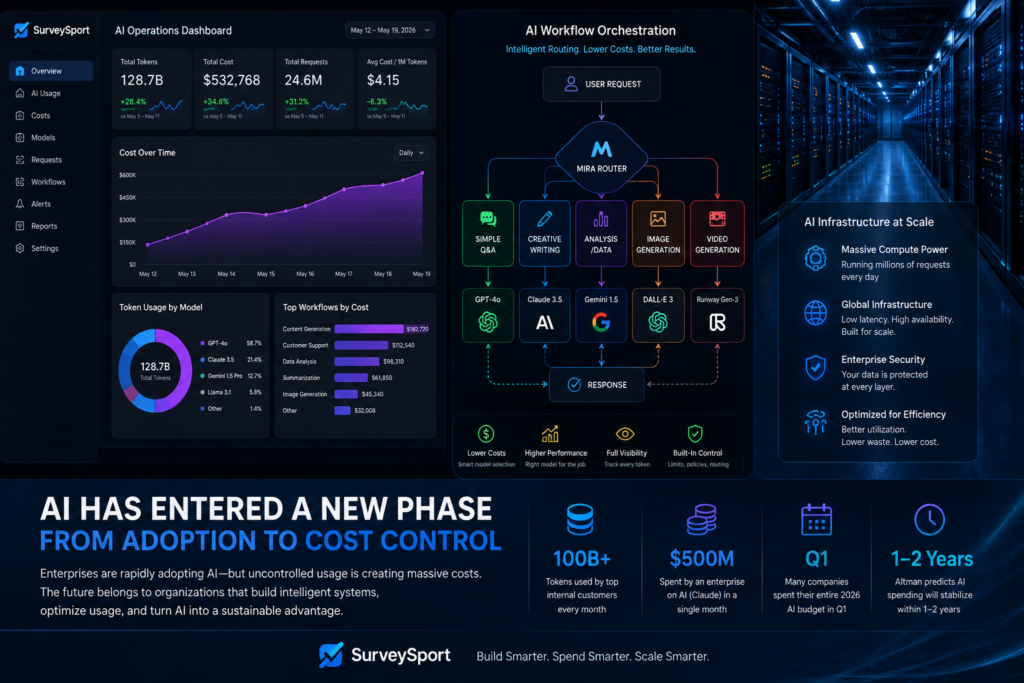
The problem is not necessarily that AI models are becoming more expensive.
The problem is that businesses are using AI for everything.
- Customer support.
- Marketing.
- Sales.
- Content creation.
- Data analysis.
- Internal knowledge systems.
- Automation workflows.
- Software development.
What starts as a small monthly expense can quickly scale into a major operational budget item when thousands or millions of AI requests are processed every day.
Why Cost Management Matters
Many organizations rushed to deploy AI before building proper governance around usage.
As a result, they are now implementing:
Usage monitoring
Cost accounting
Model selection policies
Workflow optimization
Response caching
Provider routing
AI infrastructure management
This shift mirrors what happened during the early days of cloud computing. Companies initially focused on adoption, then later discovered the importance of optimization, governance, and cost control.
AI is following a similar path.
The Next Competitive Advantage

The next generation of successful AI businesses may not be those with the largest models or the most AI tools.
Instead, they may be the organizations that can:
Deliver better results with fewer tokens
Route requests to the most appropriate models
Automate repetitive tasks efficiently
Track AI return on investment
Reduce waste while maintaining performance
In other words, the future belongs to companies that treat AI as infrastructure rather than a novelty.
What This Means for Small Businesses
For small businesses and creators, this trend presents an opportunity.
While large enterprises struggle with massive AI budgets, smaller organizations can build lean, efficient AI systems from the start.
By focusing on automation, intelligent workflows, and measurable outcomes, businesses can gain the benefits of AI without unnecessary complexity or expense.
Final Thoughts
The AI conversation has evolved.
The question is no longer whether businesses should use AI.
Most already are.
The real challenge now is building systems that make AI efficient, scalable, and profitable.
The companies that solve that challenge will be the ones leading the next phase of the AI economy.